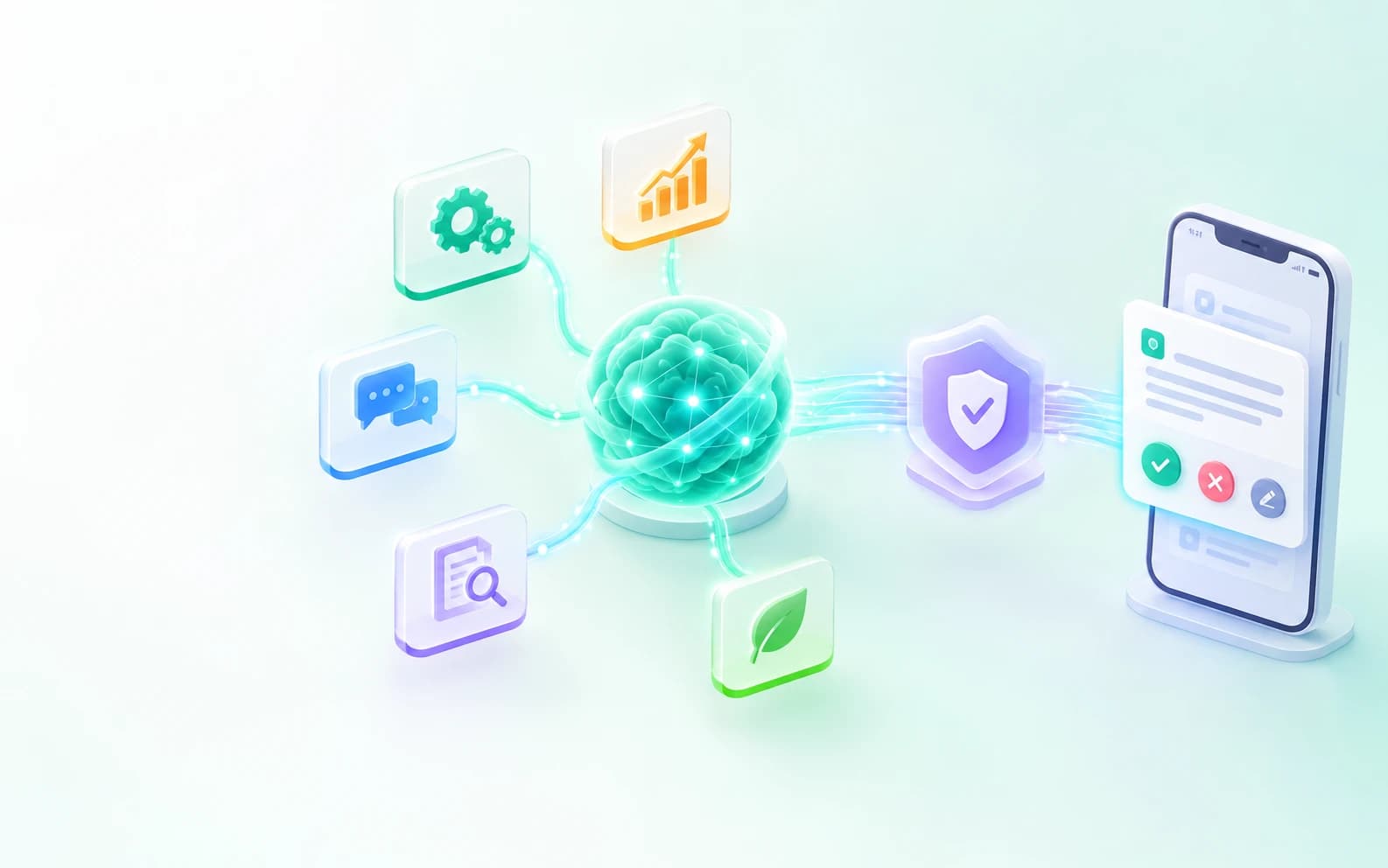
AI Operations Brain is a multi-agent AI platform that doesn't just answer questions — it proposes actions, constrained by your business's core values, and always asks a human before it acts.
of proposals pass a Constitution check before reaching an approver
100%100%
of proposals pass a Constitution check before reaching an approver
The problem
Data is siloed across sales software, CRM, accounting, inventory and chat channels.
Overload, understaffing and stock-outs are handled only after they happen.
Customers wait too long, cost leakage goes unnoticed, and leaders fear AI making the wrong call.
The solution
Unify operational data into one system that analyzes, predicts and proposes actions.
Every proposal is checked against the AI Constitution — the business's core values.
Risk-based routing: small things run automatically, important ones wait for human approval.
Benefits
Proactive operations with early warnings instead of firefighting.
Faster customer response on every channel.
Humans stay in control, and every action is fully audit-logged.
Architecture
Four technology layers, one brain
Data foundation
Event Bus, Data Warehouse, Vector DB and Audit Store turn scattered data into actionable insight.
Intelligence
LLM reasoning, semantic search (RAG), analytics and forecasting models (ML/Forecast).
Orchestration
A durable workflow engine: crash-safe, with checkpoints, resume and a full audit trail.
Interaction
An approval chat channel (Telegram), real-time alerts and webhooks to other systems.
AI Constitution
Not prompt engineering, but an independent, version-controlled policy engine that keeps every recommendation aligned with the business's values.
Human approval
Every meaningful action reaches a person with a clear explanation — one tap to decide.
Details
How AI Operations Brain works
How it works — the safe loop
Trigger: a new order, message, review, data change or scheduled check.
Agent processes: the relevant specialized agent analyzes the situation.
Constitution check: the proposal is tested against the business's values — Pass, Flag or Reject.
Risk routing: low risk is executed automatically with a notification; medium or high risk waits for approval in the chat channel; constitutional violations are rejected and logged.
Human decides: Approve, Reject or Modify with one tap.
Execute and audit: the action runs and every step is logged.
AI Constitution — rule categories
The rule set is customized for each business. Typical categories include:
Customer first: never sacrifice customer experience for short-term revenue.
Staff wellbeing: never overload staff; respect work-life balance.
Community harmony: no decisions that harm the community or partners.
Sustainability: ESG compliance and environmental responsibility.
Financial prudence: no financial risk beyond approved thresholds.
Brand integrity: all communication stays true to the brand voice.
Constitution governance
Rules are stored as versioned files in Git, changed only with approval, fully audit-logged and reviewed periodically. Every override becomes a learning signal.
Example of a proposal sent for approval
Proposal: adjust the price of product group A by +15% during peak season. Reason: the demand forecast is rising strongly and a competitor has already adjusted. Constitutional check: PASSED. Risk level: MEDIUM. The approver chooses Approve, Reject, Modify or Detail right in the chat channel.
Safeguards
No response within 30 minutes triggers an automatic escalation to the next role.
Urgent items such as customer complaints or safety issues are sent as push notifications with an SMS fallback.
Leaders can override the Constitution (logged and flagged); too many overrides trigger a Constitution review.
The specialized agents (7-agent model)
One brain, several specialists working together. Agents never call each other directly — they coordinate through a shared event bus. The number and type of agents is configured per business.
Operations: monitors processes, resources and system load; predicts overload or incidents hours ahead.
Customer service and communication: multi-channel inbox, intent classification, personalized reply drafts.
Auditor: cost anomaly detection and root-cause analysis from complaints and incidents.
Culture and ESG: ESG metrics, staff morale, community sentiment, sustainability KPIs.
Constitution Guardian: an independent policy engine that every output passes through first.
Human-in-the-Loop: chat approval, overrides, audit trail and role-based access.
Data sources — one unified view
Operations: business software (ERP/PMS/POS), task system, rosters, process checklists.
Customers and communication: CRM, social media, email, sales-channel messages.
Commerce: transactions, accounting and finance, inventory.
External signals: weather, search trends, user data.
People and ESG: staff surveys, energy and water meters, community feedback.
Target impact (when deployed)
These are targets set for a deployment and depend on the industry and each business's input data — they are not results already achieved.
Revenue per unit: target +15–25% within 6 months (industry-dependent).
Customer response time: target under 15 minutes across all channels.
Early incident detection: target a warning at least 48 hours ahead for overload scenarios.
Cost leakage: target a 10–15% reduction.
Customer satisfaction and review score: target a clear improvement within 12 months.
Constitution compliance: 100% of recommendations checked before reaching an approver (by design).
Employee morale and ESG: target improvement versus baseline.
Phased delivery roadmap
Phase 1 — Discovery and foundation (4–6 weeks): data audit, AI Constitution v1, architecture.
Phase 2 — Data platform and core infrastructure (6–8 weeks): ingestion pipelines, unified store, workflow engine, approval channel.
Phase 3 — MVP proof of value (8–10 weeks): the 3 highest-value use cases for the business.
Phase 4 — Full agent suite (8–12 weeks): expand by domain, cross-agent workflows.
Phase 5 — Hardening and handover (4–6 weeks): performance and cost tuning, security, documentation, training.
A good fit for
Retail and commerce, hospitality – resorts – F&B, manufacturing, logistics, education, healthcare and financial services — any business running on many disconnected data systems.
FAQ
Frequently asked questions
How is AI Operations Brain different from a chatbot?+
A chatbot answers questions. AI Operations Brain watches operational data, analyzes it and proactively proposes actions — always bound by the business's values and waiting for a human to approve.
What is the AI Constitution?+
An independent, version-controlled policy engine holding the rules that express the business's core values. Every agent proposal is checked against these rules before it reaches an approver.
Does the AI make decisions on its own?+
Only low-risk items are executed automatically, with a notification. Medium- or high-risk items always wait for an approver in the chat channel, and proposals that violate the Constitution are rejected and logged.
How long does a deployment take?+
The roadmap has five phases, from discovery and foundation to hardening and handover. A business can start with its three highest-value use cases in the MVP phase and expand from there.
Which industries is it suited to?+
Retail, hospitality – resorts – F&B, manufacturing, logistics, education, healthcare, financial services, and any business running on many disconnected data systems.
Want an operational brain for your business?
Share your operational challenges and NTA will help you pick the right use cases to start with.